
Business
We asked AI to fix McDonald’s Blackburn mural. We wish we hadn’t!

After McDonald’s AI-generated Blackburn mural made national headlines for featuring buildings that don’t actually belong in Blackburn, we decided to have a little fun of our own. We asked artificial intelligence to create two alternative versions. The first was deliberately ridiculous. The second was supposed to be accurate. We’ll let you decide which was more successful.
Version 1: The McDonald’s masterpiece
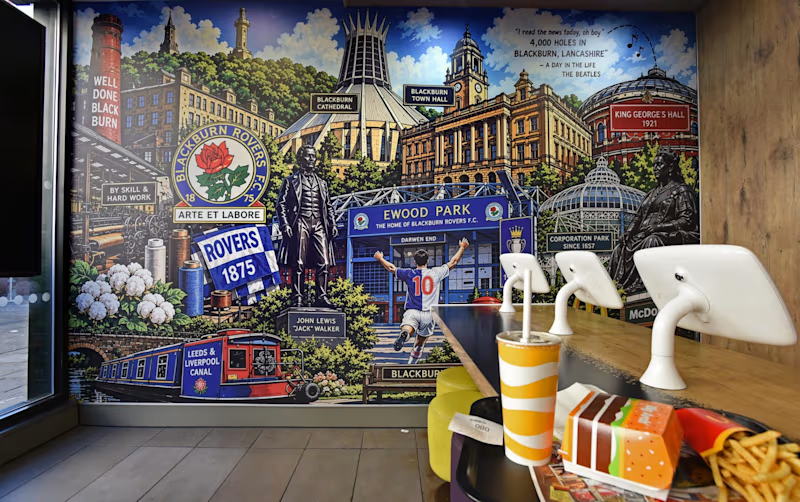
By now, most people in Blackburn will have seen the mural at McDonald’s on King William Street.
Intended as a colourful celebration of our town’s heritage, it managed to include what looks suspiciously like Liverpool Metropolitan Cathedral, a rather questionable Town Hall and a King George’s Hall that appears to have taken inspiration from London’s Royal Albert Hall.
There are also some interesting interpretations of Blackburn Rovers history, a statue with a confused identity and enough artistic licence to qualify for its own planning application.
To be fair to McDonald’s, the idea was a good one. A colourful mural celebrating Blackburn and Darwen’s history, landmarks and achievements is something we’d wholeheartedly support.
It’s just a pity that several of the landmarks appear to belong somewhere else.
And that got us thinking.
What would happen if we asked AI to have another go?
Version 2: AI goes completely rogue
For our first experiment, we uploaded the original photograph to ChatGPT and asked it to create something even more ridiculous, but genuinely funny.
And, for once, AI understood the assignment perfectly.
Blackburn Cathedral was replaced by the Leaning Tower of Pisa.
Blackburn Town Hall became Big Ben.
King George’s Hall was now the Taj Mahal, apparently operating as its Delhi branch.
A huge dinosaur wearing a Blackburn Rovers scarf appeared to be enjoying a burger, while a flying saucer abducted a cow over the town.
There was Stonehenge on the hillside, a Dalek, a pirate ship, and a canal boat proudly advertising Wi-Fi.
John Lewis had acquired sunglasses, a McDonald’s gold chain and two additional identities, with Jack Walker and Ronnie Pickering joining him on the statue’s plaque.
And perhaps our favourite addition?
Blackburn was now officially twinned with Las Vegas.
There was even a DeLorean apparently travelling through time, possibly attempting to escape before anybody asked it to explain the local geography.
It was gloriously bonkers.
But here’s the thing.
We’d asked AI to be ridiculous, and it had delivered.
Every silly addition was intentional, and the result was a wonderfully chaotic parody of the original mural.
If only accuracy were quite so easy.

Version 3: Right, enough messing about. Let’s get it right.
Having thoroughly enjoyed our AI-generated journey into Jurassic Blackburn, we decided to try something more serious.
This time, we started from scratch.
No dinosaurs. No flying saucers. No borrowed landmarks from London, Liverpool or India.
We asked ChatGPT to create a colourful but historically and architecturally accurate mural celebrating Blackburn and Darwen.
And we weren’t vague about it either.
We specifically named the buildings we wanted. We asked for accurate representations of Blackburn Cathedral, Blackburn Town Hall, King George’s Hall, Darwen Tower, Corporation Park Conservatory and Ewood Park.
We even researched architectural descriptions of the real buildings to help AI get things right.
Surely this time it couldn’t go wrong?
Well…
The resulting picture was certainly attractive.
There were cotton mills, flowers, a canal boat, Darwen Tower and a rather impressive football stadium.
But once again, Blackburn’s buildings had undergone some mysterious architectural transformations.
Blackburn Cathedral was still a Gothic creation bearing little resemblance to the real cathedral.
Our Town Hall had acquired an entirely different appearance.
King George’s Hall was once again a grand building that wouldn’t look particularly familiar to anyone walking down Northgate.
Corporation Park Conservatory looked rather more glamorous than the historic building we know, and Ewood Park appeared to have benefited from a major redevelopment that Blackburn Rovers might be interested to hear about.
It was a beautiful picture.
It just wasn’t a particularly accurate one.
And this was after we’d explicitly told AI to research the buildings and get them right.
We were beginning to think the dinosaur version was the more convincing of the two.

So, what have we learned?
Well, first of all, artificial intelligence is remarkably good at drawing a dinosaur in a Blackburn Rovers scarf.
We can’t fault it there.
It’s also capable of producing detailed, colourful images in seconds, creating things that would once have taken hours or days to illustrate.
But here’s the problem.
Something can look absolutely fantastic and still be completely wrong.
AI can reproduce the idea of a cathedral, a town hall or a historic theatre without necessarily knowing what the actual building looks like.
It can confidently label a building Blackburn Cathedral even when anyone who’s ever walked through Cathedral Quarter can see that it isn’t.
And perhaps that’s the bigger lesson in all this.
We’re constantly hearing about how artificial intelligence is going to revolutionise creative industries, replacing the work of artists, designers, illustrators and photographers.
Businesses are understandably attracted by the promise of instant artwork at a fraction of the traditional cost.
But what happens when we start replacing real knowledge, experience, creativity and local understanding with something that merely looks convincing?
A local artist knows Blackburn. They know its buildings, its history, its people and its character.
They can walk around the town, study its architecture, talk to residents and understand what makes a place special.
They can also tell the difference between Blackburn Cathedral and a building in Liverpool.
Which, on the evidence of our experiment, is quite a valuable skill.
To McDonald’s credit, the company has said it intends to commission a local artist to create a replacement mural.
We think that’s an excellent idea.
Blackburn and Darwen have some incredibly talented artists and designers, and we’d love to see one of them given the opportunity to produce something that genuinely celebrates our borough.
So perhaps there’s a lesson for businesses everywhere.
Before AI puts all our talented creative people out of work, maybe we should try paying them to create something brilliant instead.
In the meantime, we’ve included all three pictures for your entertainment.
Which is your favourite? How many mistakes can you spot? And what would you include in a mural celebrating Blackburn and Darwen?
Let us know in the comments.
And if McDonald’s ever needs a dinosaur in a Blackburn Rovers scarf, we know just the robot for the job.